Finding the solution he'd already been looking for
Before joining DA-Group as Chief Operating Officer, Tero Marjamäki worked at another large production company with several factories. There, he had been searching for a way to give shop-floor workers reliable, shared access to the company's ERP system, without the risk of one worker's session bleeding into the next. He never found the right fit.
Then he started at DA-Group and realized the answer had already been in place for years: a Hublet shared-tablet setup running on the production floor.
About DA-Group
DA-Group is a Finnish provider of advanced electronics and high-technology solutions, serving industrial, defence, aerospace, and space customers globally, from R&D and testing through manufacturing and life-cycle services.
DA-Group holds a distinct place in Hublet's customer base: it is also Hublet's own production partner, manufacturing Hublet's docking stations and tablet covers. DA-Group has been using Hublet in its own production facility for four years now.
The challenge
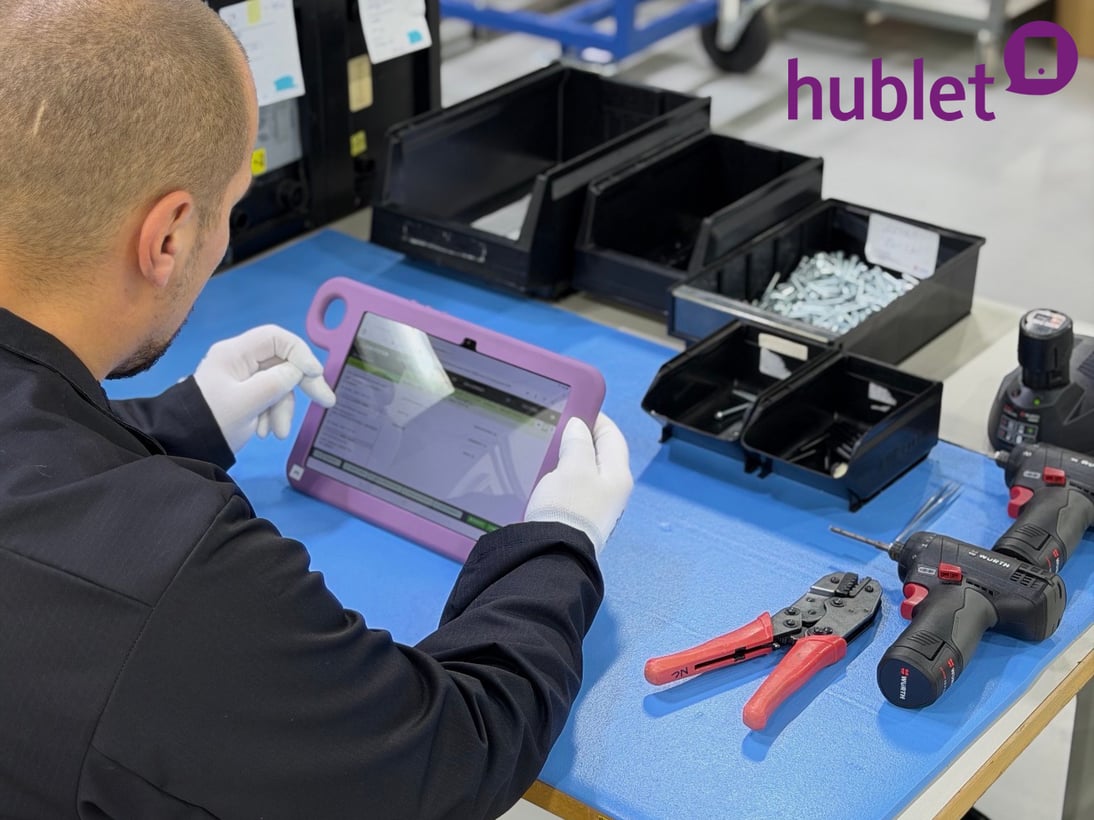
About 40 workers build products across DA-Group's production facility, each logging into the company's ERP system to record progress on their assigned tasks. Alongside logging their own work, workers also need quick access to reference material, such as assembly images, right at the workstation while they build.
With that many people sharing a pool of devices, the risk isn't primarily about privacy, it's about production accuracy. If a tablet isn't fully reset between users, one worker could unknowingly continue a previous worker's open session: marking a task as done that wasn't, or logging progress against the wrong job. In a manufacturing environment feeding directly into the ERP, an error like that can ripple into wrong inventory counts, missed quality checks, or incorrect production records.
The setup
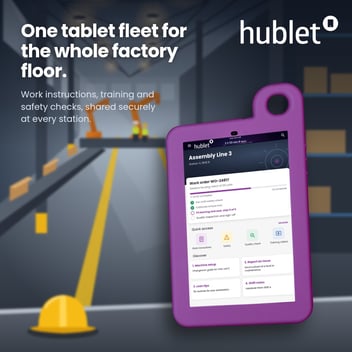
DA-Group runs 4 Hublet tablet docks positioned around the production floor, holding 24 tablets in total.
|
Step |
What happens |
|
Start of shift |
Worker picks up any available tablet from a dock |
|
Log in |
Worker logs into DA-Group's ERP system on the tablet |
|
During the shift (up to 10 hours) |
Worker marks progress on production tasks as they're completed |
|
End of shift |
Tablet is returned to its dock |
Between each pickup, Hublet resets the tablet, so every worker starts from a clean session on whichever device they happen to grab. No tablet is assigned to a specific person.
That same shared tablet also solves a second need: workers can pull up reference material, such as assembly images, right at the workstation, wherever DA-Group's own systems support it.
The benefits
Data integrity and mistake prevention
In many Hublet deployments, the automatic reset between users is mainly a privacy and GDPR safeguard, ensuring no personal data lingers from one user to the next. At DA-Group, that same reset serves a different, equally important purpose: preventing production errors.
Because every tablet returns to a clean state between users, there's no risk of a worker accidentally staying logged into a previous session and continuing, or overwriting, someone else's in-progress work. That removes a specific failure mode: wrong data logged against the wrong task or job in the ERP system.
This matters more at DA-Group than it might elsewhere. Alongside its industrial customers, DA-Group also serves the space and defence sectors, where the tolerance for error in production and traceability is extremely low. As that part of the business grows, the stakes riding on clean, reliable session handling grow with it.
Time savings through automation
On top of that, Hublet removes friction from the daily routine. Workers don't need to track down their own assigned device, any tablet on the dock works as their own the moment they log in. The reset, charging, and device management all happen automatically, so no one spends time on setup or troubleshooting shared hardware.